
Grid-Forming
Grid-Forming Inverter Testing and Validation
With the widespread adoption of additive technologies, the nature of the public grid has fundamentally changed. In addition to a few “classical” large power plants, countless smaller, decentralized micro-generators are now feeding power into the grid. To ensure the stability and reliability of such
grids, highly complex measures—such as mutual synchronization and harmonization—are necessary. REGATRON power equipment is ideally suited for all investigation work and test procedures on complex grids due to its precision, high dynamics, and high available power.
Grid-Forming Testing at a Glance
- Grid-Forming establishes the grid reference: Grid-forming inverters actively control voltage, frequency, and phase angle, enabling stable operation even in weak grids or islanded microgrids.
- Grid-Following depends on an existing grid reference: Grid-following inverters synchronize to the prevailing grid voltage and frequency and inject controlled current, making their operation dependent on a stable external grid.
- Advanced validation requires realistic grid conditions: Dynamic tests such as phase jumps, frequency disturbances, weak-grid operation, islanding, and impedance analysis can be reproduced with REGATRON’s high-performance AC/DC power equipment and P-HIL solutions.
Modern power grids, which are interconnected with microgrids and decentralized energy sources, have to expand their operational strategies from the traditional centralized architectures to complex ecosystems. Participating inverters must be carefully and precisely synchronized and coordinated with one another to ensure the required grid stability.
This leads to the fundamental question: Who controls the grid’s key parameters, such as voltage and frequency—and, among the interconnected sources, who is responsible for ensuring that common parameters are maintained? Unlike Grid-Following (GFL) inverters that act as current sources and rely on an external grid voltage, Grid-Forming (GFM) inverters function as self-synchronizing voltage sources that can independently anchor a microgrid.
Grid-Forming vs Grid-Following
Grid-Forming vs Grid-Following
Grid-forming and grid-following inverters interact with the electrical grid in fundamentally different ways. A grid-forming inverter actively establishes a voltage and frequency reference, while a grid-following inverter synchronizes with an existing grid. These differences also result in different requirements for inverter testing and validation.
| Characteristic | Grid-Forming | Grid-Following |
|---|---|---|
| Grid reference | Establishes the voltage and frequency reference | Follows an existing grid voltage and frequency reference |
| Synchronization | Maintains synchronism while actively forming the local voltage waveform | Synchronizes its output to the existing grid |
| Control focus | Voltage, frequency, and power interaction with the grid | Current injection and active or reactive power control |
| Grid dependency | Can support operation under weak-grid or islanded conditions | Depends on an external grid reference for normal operation |
| Testing focus | Dynamic stability, synchronization, frequency response, and grid-support behavior | Synchronization, current control, and response to changing grid conditions |
Advanced Validation Requirements for Grid-Forming Technology
The successful deployment of grid-forming inverters depends on their ability to maintain stable system operation under a wide range of grid conditions. Consequently, validation extends beyond standard grid-code compliance and focuses on the dynamic interaction between the inverter, the electrical network and other grid-connected assets.
Typical investigations include operation in weak grids with low Short-Circuit Ratios (SCR), seamless transitions to islanded operation, fast transient response to phase and frequency disturbances, and frequency-domain stability analysis. These scenarios require highly dynamic power equipment with precise control of voltage, frequency, phase angle and grid impedance.
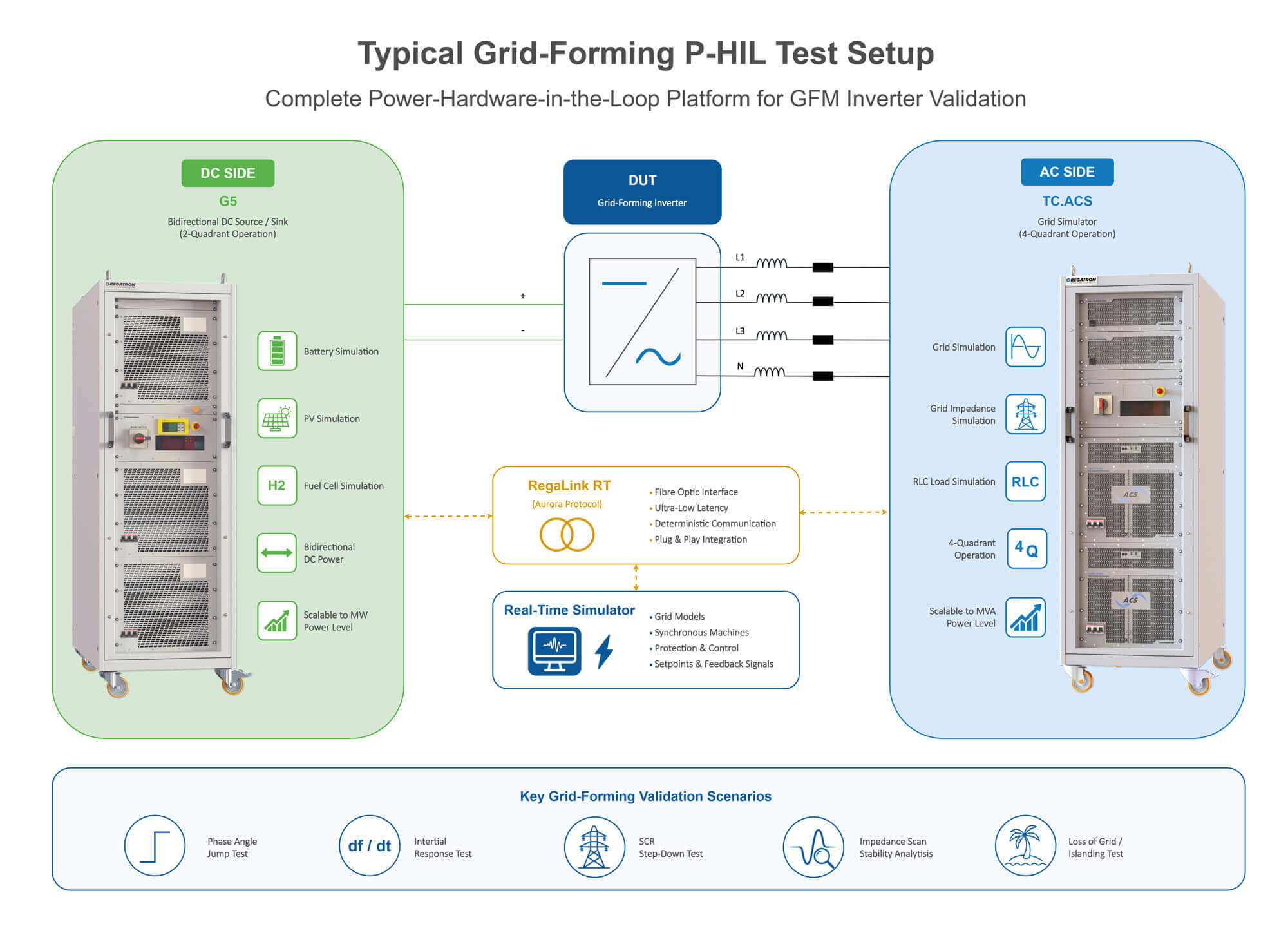
To reproduce such conditions with high accuracy, modern test environments frequently employ Power Hardware-in-the-Loop (P-HIL) testing for grid-forming inverters, combining real-time simulation with programmable AC and DC power hardware. This approach provides a realistic and repeatable framework for grid forming inverter validation before field deployment.
Grid-Forming-Based Test Scenarios
Grid forming inverter testing and validation uses defined test scenarios to reproduce critical grid events under controlled conditions. Each test focuses on a specific disturbance and evaluates how the inverter responds, how quickly it stabilizes, and whether it maintains the required grid-support behavior.
Typical scenarios include phase angle jumps, frequency disturbances, changes in grid strength, impedance-based stability analysis, and loss of grid or islanding events.
Phase Angle Jump Test
Phase Angle Jump Test
The grid simulator applies an instantaneous phase-angle step to emulate a severe grid disturbance. The grid-forming inverter must maintain synchronization and rapidly stabilize its power output without losing control. Measured results include active power transient response, settling time, and oscillation damping, providing a clear indication of the inverter’s dynamic stability and grid-support capability.

Inertial Response Test
Inertial Response Test
The grid simulator applies a controlled frequency ramp to emulate a grid frequency disturbance. The grid-forming inverter must provide virtual inertia by automatically adjusting its active power output in response to the Rate of Change of Frequency (RoCoF). The test verifies the inverter’s ability to support grid stability during frequency events and emulate the behaviour of conventional synchronous generators. Measured results include the active power response, response time, and the achieved virtual inertia constant, providing a clear indication of the inverter’s grid-support capability.
SCR Step-Down Test
SCR Step-Down Test
The grid simulator progressively reduces the Short Circuit Ratio (SCR) to emulate increasingly weak grid conditions. The grid-forming inverter must maintain stable operation, synchronization, and power control as the grid strength decreases. This test identifies the stability limits of the inverter and verifies reliable operation in weak and converter-dominated power systems.
Measured results include voltage and frequency stability, power response, and the minimum SCR level at which stable operation can be maintained.

Impedance Scan & Stability Analysis
Impedance Scan & Stability Analysis
Controlled frequency-domain perturbations are injected to determine the impedance response of the Grid-Forming inverter. The resulting impedance profile is used to assess stability, identify potential resonances, and verify robust interaction with the electrical grid. Key results include impedance magnitude, phase characteristics, and frequency-domain stability margins.

Loss of Grid / Islanding Test
Loss of Grid / Islanding Test
The grid simulator initiates a controlled grid disconnect to emulate an islanding event. The grid-forming inverter must immediately establish and maintain a stable voltage and frequency reference without relying on an external grid source. This test verifies seamless transition from grid-connected to islanded operation and demonstrates the inverter’s ability to sustain stable microgrid operation.
Measured results include voltage and frequency stability, transition time, load-step response, and overall system recovery following the loss of grid connection.

Why REGATRON for Grid-Forming Testing
REGATRON combines AC grid simulation, programmable DC source simulation, and Power-Hardware-in-the-Loop capabilities in a single integrated test platform. TC.ACS reproduces grid dynamics on the AC side, while G5 emulates batteries, PV sources, and other DC energy systems.
The high-speed RegaLink RT fibre-optic interface, based on the Aurora Protocol, bridges the gap between REGATRON power hardware and leading Real-Time Simulators such as OPAL-RT, RTDS, Speedgoat, and Typhoon HIL, enabling seamless low-latency closed-loop testing for advanced Grid-Forming and P-HIL applications.
Together, ACS, G5, and RegaLink RT provide a scalable platform for comprehensive grid forming inverter testing and validation, from early controller development to full-scale P-HIL verification and grid-code compliance testing.
Suitable Products
ACS Series
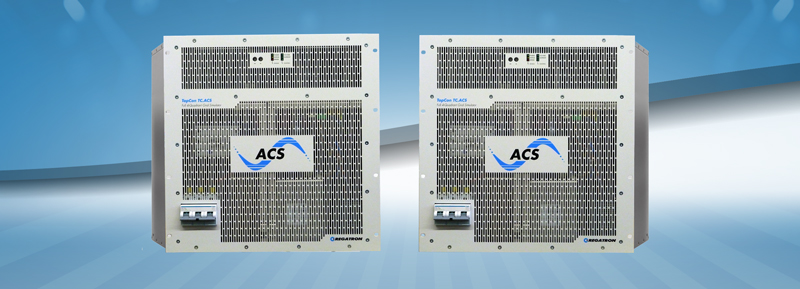
The established and versatile TC.ACS series features advanced CV/CC/CP/RLC power waveform generation with a base frequency range of 0…1 kHz and a spectrum of harmonics up to 5 kHz. It supports full four-quadrant operation, including DC mode, and is ideally suited for a wide range of demanding laboratory and industrial applications, such as smart grid research and simulation, AC load bank operation (RLC/CC/CP), and EoL testing.
- Power Range: 0…30 to 0…2000+ kVA
- Voltage Range: 0…528 Vrms (L-L) (higher on request)

G5.RSS Series
The G5.RSS series integrates Regatron’s cutting-edge technology in a compact, space-saving design. It features rapid transient response (50…100 µs), ripple modulation up to 10 kHz, and high-precision current and voltage regulation. Its switchable output capacitance ensures stability and maximum dynamic response in both CV and CC modes. Ideally suited for a wide range of demanding laboratory and industrial applications, including testing compliant with automotive and industry standards EIS, P-HIL, and more.
- Power Range: 0…9 to 0…5000+ kW
- Voltage Range: 0…60 to 0…3000 VDC
G5.UNV Series
Comprehensive solution for testing/simulation of batteries and fuel cells, testing of (solar) inverters and chargers, and P-HIL applications. It incorporates the advanced functions of the specialized G5 series and is designed to meet diverse requirements in an environment of constantly evolving tasks in areas such as product certification, scientific laboratories, R&D, and prototyping.
- Power Range: 0…9 to 0…5000+ kW
- Voltage Range: 0…60 to 0…3000 VDC
We Are Here to Support You
Experience our commitment to outstanding customer support at every stage — before, during, and after your purchase. Benefit from our complimentary consultation services from the very beginning to ensure the
ideal solution for your needs. For added flexibility, selected power supplies may also be available for rent. Please contact REGATRON to discuss your specific requirements and to check availability for your application.
Need the Right Power Solution?
We’ll help you define the ideal setup. Contact us today for expert, personalized support.