AI Server Power
Testing Infrastructure
AI Server Power Testing
AI server power testing is becoming critical as power density in modern data centers increases rapidly. This also increases the importance of AI data center power testing across complete rack, backup, and distribution architectures. AI workloads drive server racks from a few kilowatts to hundreds of kilowatts and beyond, requiring new power architectures such as HVDC distribution and Grid-to-Chip designs.
These changes introduce higher voltages, faster dynamics, and more complex system interactions. To ensure reliable operation, power supplies, power shelves, and complete energy paths must be validated under realistic conditions. Advanced test equipment enables engineers to simulate real-world behavior, verify performance, and ensure stability across component and system levels in AI power infrastructure.
AI Server Power Testing at a Glance
- Goal: Validate AI server power systems under realistic conditions to ensure performance, stability, and reliability from component level to full infrastructure.
- Focus: AI server power testing and AI power testing across scalable architectures, from single modules to multi-megawatt Grid-to-Chip systems.
- Typical targets: power supplies (PSU), powershelves, Battery Backup Units (BBU), Capacity Backup Units (CBU), HVDC sidecars, Solid-State Circuit Breakers (SSCB), Solid-State Transformers (SST), and busbar systems.
Why AI Server Power Testing Requirements Are Changing
AI workloads are driving a rapid increase in power density within modern data centers. Server racks are moving from a few kilowatts to hundreds of kilowatts, requiring new power architectures and more advanced validation methods. At the same time, higher voltages and tighter integration between components increase the complexity of system behavior and testing. As a result, AI data center power testing is becoming essential for validating both component performance and full system interaction.
- Higher power density: AI servers require significantly more power, increasing thermal, electrical, and dynamic stress on components
- New voltage architectures: HVDC, 400 VDC, and 800 VDC systems reduce losses but introduce new testing challenges
- System-level interaction: reliable validation must include both individual components and their behavior within the full power system
AI Server Power Testing for Grid-to-Chip Architectures
AI server power architectures are evolving from integrated rack designs to HVDC-based and direct-conversion systems.
This shift increases system complexity and requires scalable, high-precision AI server power testing across the entire power path.
- Integrated rack systems: validation of combined power supply (PSU) and compute environments at rack level
- HVDC sidecar architectures: testing of high-voltage distribution, powershelves, and externalized power systems
- Grid-to-Chip and SST-based systems: validation of direct conversion, Solid-State Transformers (SST), and full energy paths
As AI infrastructure scales to multi-megawatt systems, testing must move beyond component validation to full system-level verification.
This includes dynamic behavior, high-power conditions, and realistic interaction across the entire power system.
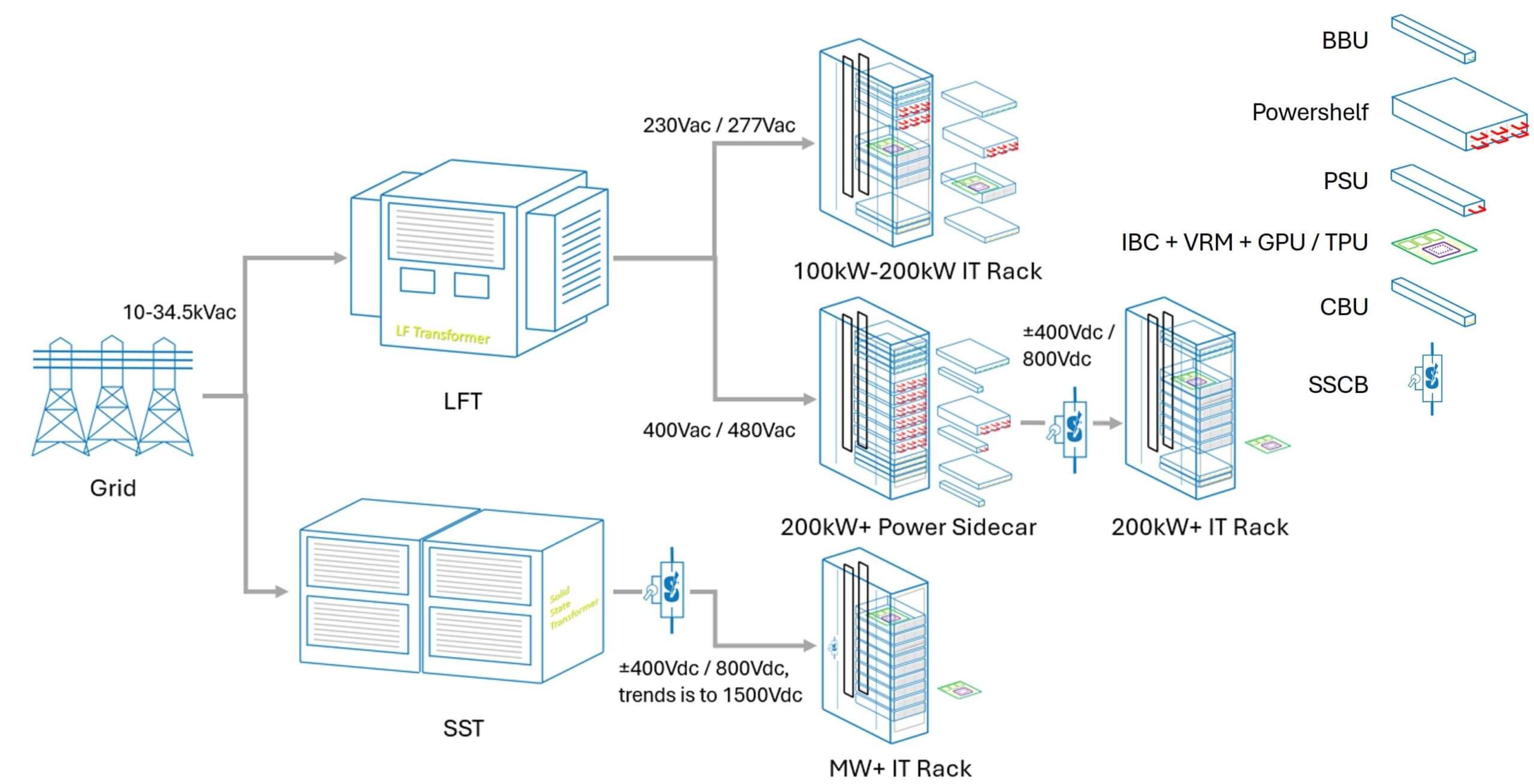
LFT: Low Frequency Transformer
SST: Solid State Transformer
BBU: Battery Backup Unit
PSU: Power Supply Unit
IBC: Intermediate Bus Converter
VRM: Voltage Regulator Module
GPU: Graphics Processing Unit
TPU: Tensor Processing Unit
CBU: Capacitor Backup Unit
SSCB: Solid State Circuit Breaker
Scalable AI Server Power Testing
REGATRON enables scalable testing from individual components to complete AI data center power systems. Modular test setups allow engineers to start with subsystem validation and expand to multi-megawatt Grid-to-Chip testing environments.
Stable and Software-Defined Testing
Software-defined control ensures stable and realistic test conditions, even with complex impedances and dynamic loads. This allows accurate validation of power supplies, powershelves, and HVDC systems under real operating scenarios.
Regenerative Efficiency and Lower TCO
REGATRON’s regenerative technology feeds energy back into the grid, reducing energy consumption by up to 95%. This significantly lowers operating costs and cooling requirements, resulting in a reduced Total Cost of Ownership (TCO) compared to conventional dissipative test systems.
Typical AI Server Power Testing Applications
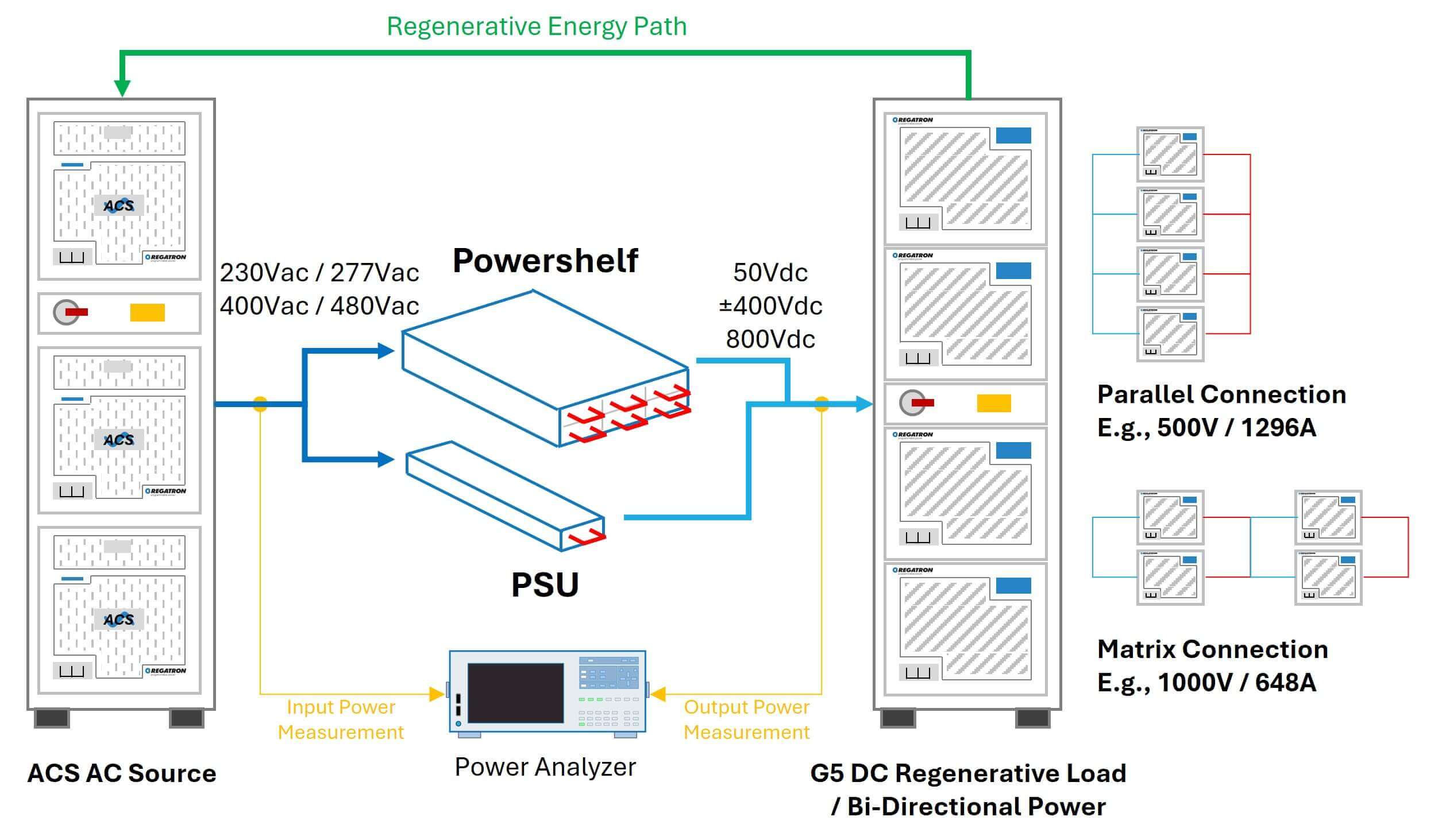
Powershelf and PSU Testing for AI Server Power Systems
Power shelves and power supplie units (PSU) are central elements of AI server power architectures. AI server power supply testing must verify efficiency, transient response, voltage stability, and behavior under rapidly changing load conditions.
This helps ensure reliable operation at rack level and provides realistic validation of the interaction between PSU stages and compute loads.
End-to-end validation with realistic load profiles and dynamic load emulation ensures that test scenarios accurately reflect real AI workloads.
- Validation of PSU efficiency, voltage stability, and transient response
- Testing of powershelf behavior under dynamic AI server load profiles
- Simulation of realistic rack-level operating conditions
BBU and CBU Testing for Backup Power Validation
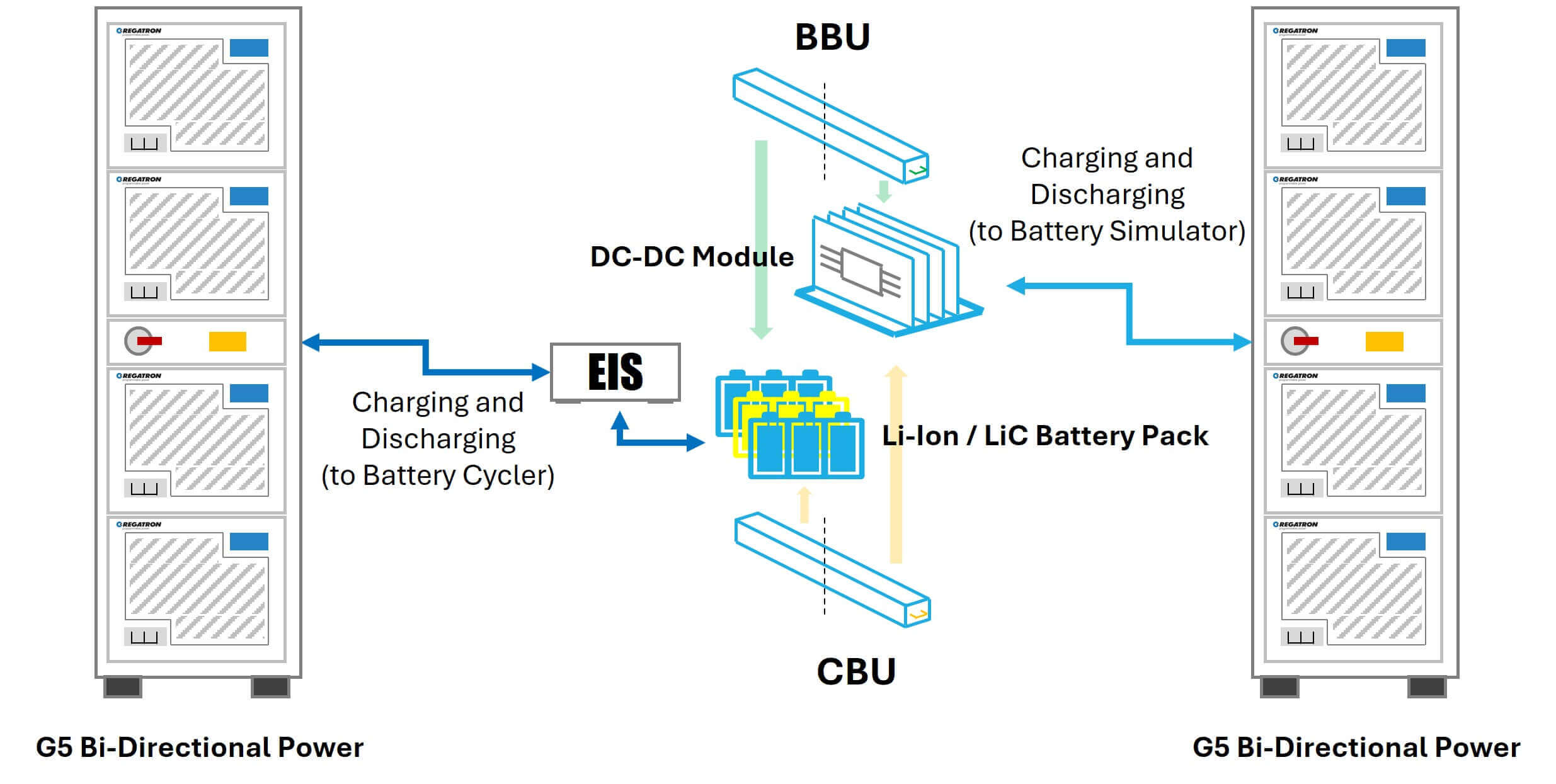
Battery Backup Units (BBU) and Capacity Backup Units (CBU) help maintain system continuity during power events and fast load transitions. Testing focuses on charge and discharge behavior, response time, and stable integration into the overall AI server power system.
- Charge and discharge cycle testing under realistic operating profiles
- Validation of response behavior during power loss and peak load events
- System-level testing of backup units within AI power architectures
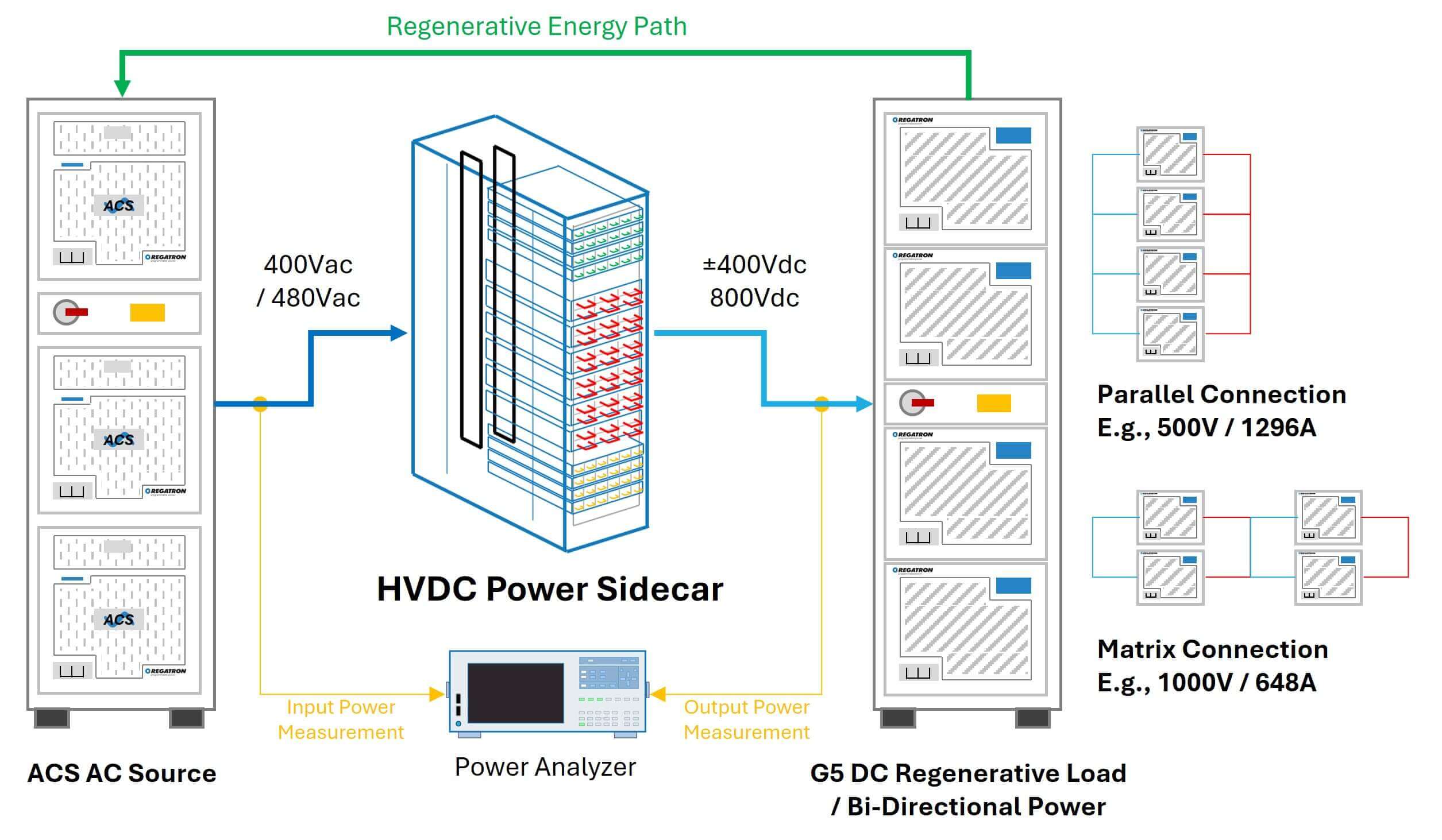
Power Sidecar Testing for HVDC Rack Architectures
Power sidecar architectures move critical power components outside the compute rack to improve space usage, thermal management, and efficiency. Testing must validate HVDC distribution, sidecar integration, and the interaction between external power stages and AI server loads.
- Validation of sidecar-based power distribution concepts
- Testing of externalized power stages under realistic rack conditions
- Verification of system interaction between sidecar and compute rack
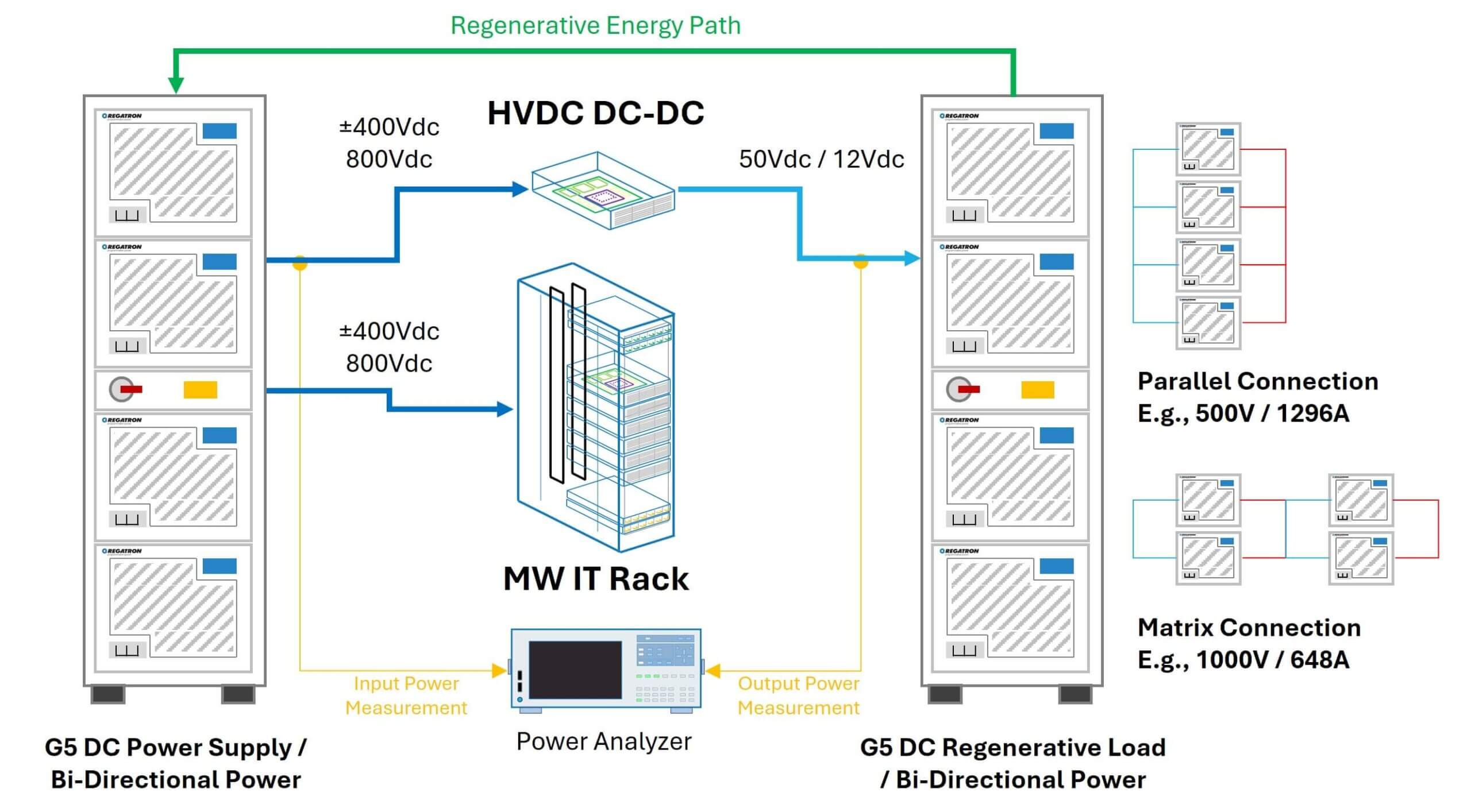
HVDC DC-DC Testing for AI Power Conversion
HVDC DC-DC converters are a key part of next-generation AI power systems. Testing must verify conversion behavior, efficiency, dynamic stability, and reliable operation under high-voltage and high-power conditions across the full energy path.
- Validation of high-voltage DC-DC conversion stages
- Testing of dynamic behavior under realistic AI power loads
- Simulation of conversion performance within Grid-to-Chip architectures
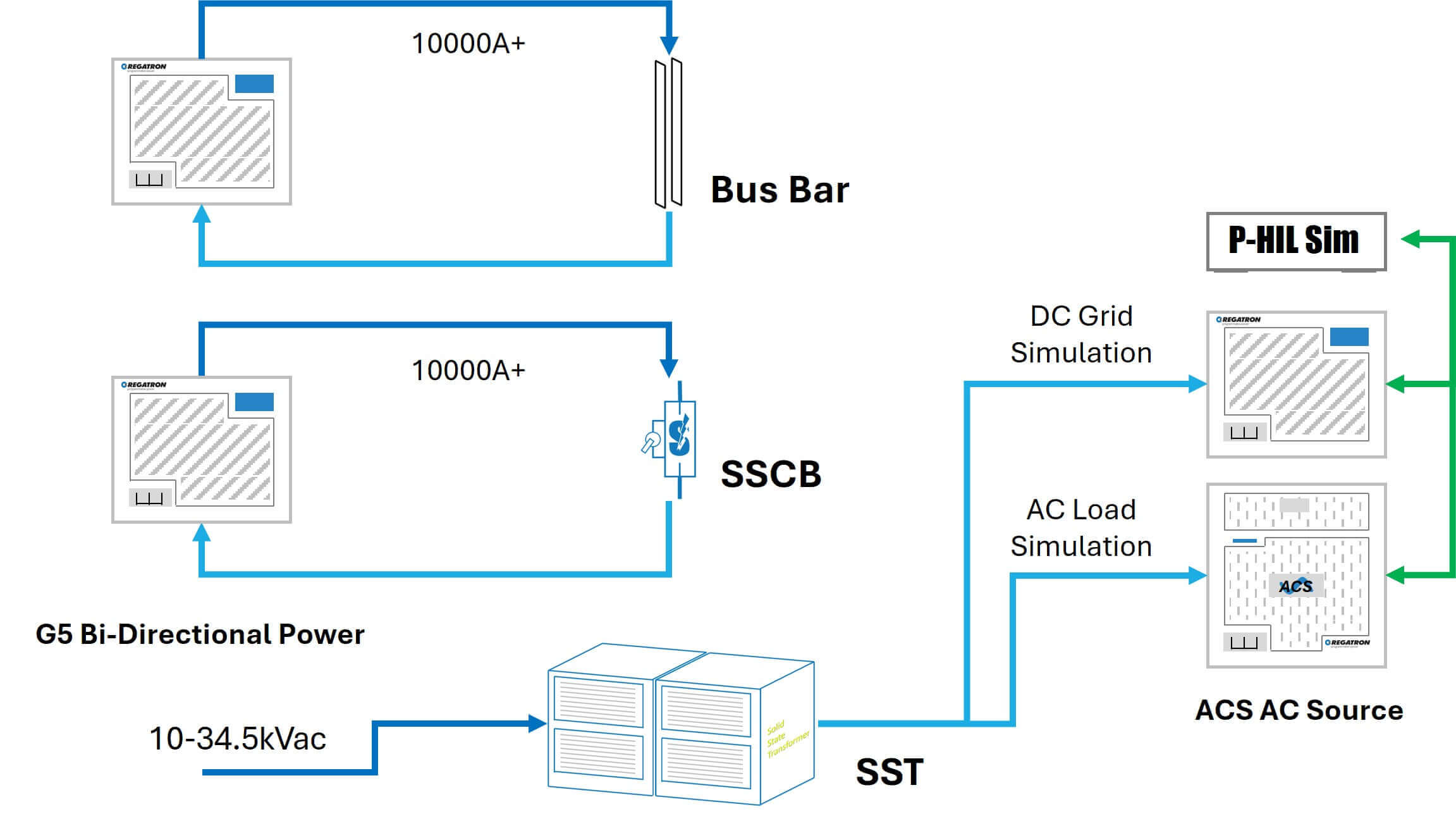
SCB, SST, and Busbar Testing for Protection and Distribution Systems
Solid-State Circuit Breakers (SSCB), Solid-State Transformers (SST), and busbar systems are critical for protecting and distributing power in advanced AI infrastructures. Testing must validate switching speed, fault behavior, high-current capability, and stable operation across demanding system conditions.
- Validation of protection behavior and switching performance
- Testing of high-voltage and high-current power distribution systems
- Integration testing of protection and conversion components in AI power architectures
Why REGATRON for AI Server Power Testing
Scalable and High-Power AI Server Power Testing
REGATRON systems are designed to scale with evolving AI power requirements. Test setups can start at component level and expand seamlessly to multi-megawatt configurations. This enables validation of everything from individual power modules to complete AI data center power infrastructures within one unified platform, supporting future Grid-to-Chip architectures.
Precision and Realistic Validation of AI Power Systems
High dynamic performance and software-defined control ensure accurate and stable test conditions. REGATRON systems deliver fast response times, low ripple, and adapt to complex impedance and load behavior. This allows realistic validation of power supplies, powershelves, HVDC systems, and complete power paths under real operating conditions.
Energy Efficiency and Lower Total Cost of Testing
REGATRON’s regenerative technology feeds energy back into the grid instead of dissipating it as heat. This reduces energy consumption by up to 95%, lowers cooling requirements, and significantly decreases operating costs. As a result, users benefit from a faster return on investment and a more sustainable testing environment.
Suitable Products

G5.RSS Series
The G5.RSS series integrates Regatron’s cutting-edge technology in a compact, space-saving design. It features rapid transient response (50…100 µs), ripple modulation up to 10 kHz, and high-precision current and voltage regulation. Its switchable output capacitance ensures stability and maximum dynamic response in both CV and CC modes. Ideally suited for a wide range of demanding laboratory and industrial applications, including testing compliant with automotive and industry standards EIS, P-HIL, and more.
- Power Range: 0…9 to 0…5000+ kW
- Voltage Range: 0…60 to 0…3000 VDC
G5.BT Series
Specialized 1- to multi-channel tester/cycler for battery modules and packs, offering adjustable, high dynamics (50…100 µs), outstanding accuracy, and application-specific safety features. It includes a dual measurement range for maximum accuracy and G5.BatControl software. Mobile racks with IP20 or IP54 ratings are available. Optimized for various battery testing applications and EIS.
- Power Range: 0…9 to 0…5000+ kW
- Voltage Range: 0…60 to 0…3000 VDC
AC Grid Simulation
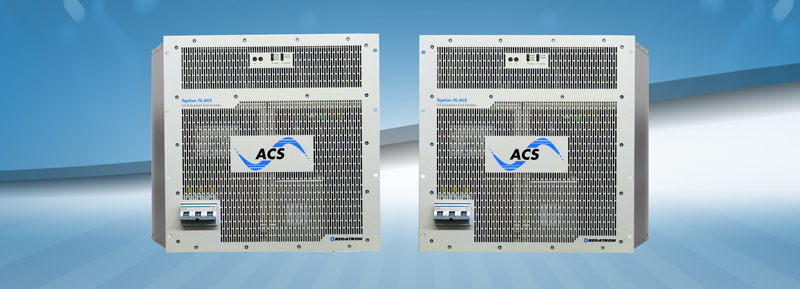
The TC.ACS series can be used as a full 4-quadrant grid simulator, offering multiple programmable operating modes: Power mode, RLC load mode, and current mode. Its flexibility makes it ideal for testing inverters (PV, V2G, ESS), chargers, OBC (11/22 kVA), drives (e.g., for elevators), grid impedance simulation, and anti-islanding testing.
- Power Range: 0…30 to 0…2000+ kVA
- Voltage Range: 0…528 Vrms (L-L) (higher on request)
Three-Phase Power Amplifier
The TC.ACS series can be used as power amplifier, featuring different operating modes (CV/CC), an analog high-speed interface, and an optional digital high-speed interface based on the Aurora protocol. The fast response capability of TC.ACS provides minimum time delays and phase errors, making it ideally suited as P-HIL-amplifier for power hardware-in-the-loop simulation.
- Power Range: 0…30 to 0…2000+ kVA
- Voltage Range: 0…528 Vrms (L-L) (higher on request)
We Are Here to Support You
Experience our commitment to outstanding customer support at every stage — before, during, and after your purchase. Benefit from our complimentary consultation services from the very beginning to ensure the
ideal solution for your needs. For added flexibility, selected power supplies may also be available for rent. Please contact REGATRON to discuss your specific requirements and to check availability for your application.
Need the Right Power Solution?
We’ll help you define the ideal setup.
Contact us today for expert, personalized support.