ACS Series
Regenerative AC Power Supply for AC Grid and Load Simulation or P-HIL Power Amplifier
CS is a programmable regenerative AC power supply for demanding AC test environments. It combines a programmable AC power supply, an AC grid simulator, a fast P-HIL power amplifier and AC load simulator in one scalable system. Customers use ACS to reproduce complex grid conditions,
test power electronics under real operating scenarios and simulate dynamic AC loads without building separate test setups. Its regenerative 4-quadrant operation feeds energy back into the AC mains and helps reduce energy consumption during high-power testing.
ACS Regenerative AC Power Supply
ACS is a regenerative AC power supply product family designed for advanced AC testing applications in power electronics, smart grids, renewable energy systems and e-mobility. The systems combine precise AC power generation, regenerative operation and flexible test functionality in one platform.
- Product family: ACS
- Primary category: Programmable AC power supply for dynamic and application-specific testing
- Secondary category: Regenerative AC power supply with 4-quadrant operation and energy recovery
- Main applications: AC grid simulation, P-HIL applications, AC load simulation, and EMC testing
- System range: From compact single units to scalable high-power systems up to 2000+ kVA
Thanks to its modular architecture, ACS can be adapted from laboratory test benches to large multi-device installations. The same platform can therefore support both development environments and high-power validation systems.
Capabilities of the ACS Regenerative AC Power Supply
ACS combines multiple AC test capabilities in one regenerative AC power supply platform. Customers can use the same system for grid simulation, dynamic power amplification and AC load simulation without changing hardware platforms.
High Dynamic Source and Sink Operation
ACS supports full 4-quadrant operation and can both source and sink power. During regenerative operation, absorbed energy is fed back into the AC mains instead of being dissipated as heat. This reduces energy consumption and cooling requirements during high-power testing. The capability is especially important for testing bidirectional systems such as inverters, chargers and grid-connected power electronics.
Programmable Waveform Generation
The integrated waveform generator allows users to simulate stable AC grids as well as dynamic grid disturbances. Voltage, frequency and phase behavior can be programmed for simple or complex test scenarios. Customers can configure test sequences such as LVRT, HVRT, FRT, and ROCOF for grid compliance and inverter testing. Harmonics and customized waveform profiles can also be generated for advanced grid simulation tasks using the available ACS options and functions.
P-HIL Power Amplifier
ACS can operate as a fast P-HIL power amplifier for real-time simulation environments.
The system combines high dynamic response with fast analog I/O for closed-loop testing.
This allows customers to connect real hardware to real-time simulators and investigate system behavior under changing electrical conditions.
Typical applications include renewable energy systems, smart grids and electric vehicle test benches.
AC Load Simulation
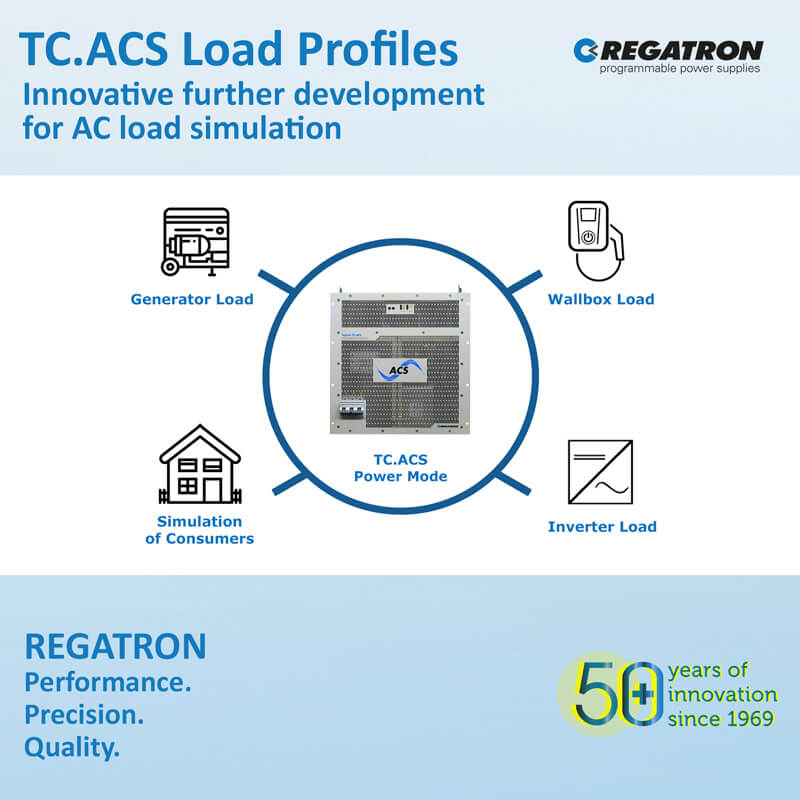
ACS also supports AC load simulation with RLC load mode, waveform generator with current curves and power mode with programmable load profiles. Static loads and dynamic load changes can be reproduced in a controlled test environment.
The RLC load mode is suitable for anti-islanding testing and for simulating resistive, inductive and capacitive load behavior. Harmonic current curves can additionally be used to test the robustness of AC sources and inverters.
Applications of the ACS Power Supply
ACS supports AC grid simulation, P-HIL applications, AC load simulation and EMC testing in one regenerative AC power supply platform.
The system is used for development, validation and compliance testing in laboratory and high-power test environments.
AC Grid Simulation
As an AC grid simulator, ACS reproduces real-world AC grid conditions in a controlled and repeatable environment. Customers can simulate stable utility grids, distorted waveforms, voltage dips, frequency variations and transient grid events for development and compliance testing.
The programmable waveform generator allows users to configure voltage, phase and frequency behavior for both simple and highly dynamic grid scenarios.
Test sequences such as low-voltage ride-through (LVRT), high-voltage ride-through (HVRT), fault ride-through (FRT) and rate of change of frequency (ROCOF) can be generated directly within the system.
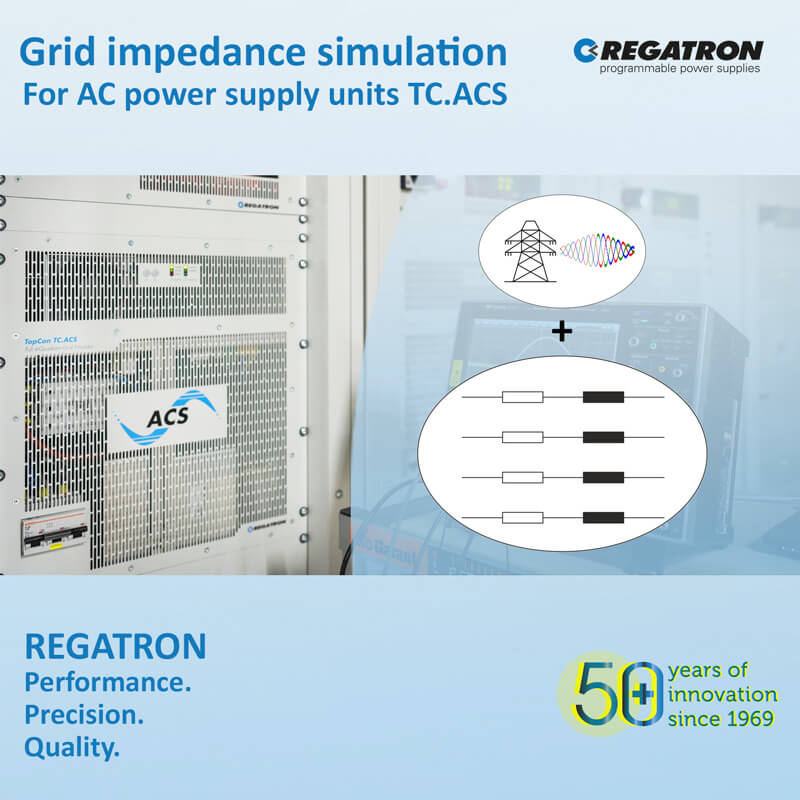
Harmonics, customized periodic waveforms and grid impedance conditions can additionally be simulated to reproduce realistic operating environments for grid-connected devices. This makes ACS suitable for validating inverter stability, grid synchronization and compliance behavior under disturbed grid conditions.
Typical AC grid simulation applications include:
- Photovoltaic inverter testing
- Battery inverter validation
- Charger and on-board charger testing
- Smart grid and microgrid simulation
- Grid compliance and certification testing
For more advanced grid simulation tasks, ACS can also simulate grid impedance to reproduce the behavior of real 50/60 Hz AC grids.
Regenerative AC Grid Simulator for Smart Grid Testing
ACS can also operate as a regenerative grid simulator. During testing, absorbed energy is fed back into the AC mains instead of being dissipated as heat.
This significantly improves overall efficiency and reduces cooling requirements during long-duration or high-power test sequences.
Regenerative operation is especially valuable in smart grid, renewable energy and energy storage applications where bidirectional power flow must be reproduced realistically. The regenerative architecture also supports sustainable laboratory operation by reducing energy losses compared to conventional dissipative load systems.
P-HIL Applications
ACS can be used as a fast P-HIL power amplifier in power-hardware-in-the-loop environments. In these setups, a real-time simulator interacts directly with physical hardware through the power amplifier. The high dynamic response and fast analog interface of ACS allow rapid signal processing between the simulator and the hardware under test. This enables customers to investigate the behavior of complex electrical systems under realistic operating conditions without requiring a complete physical power network.
P-HIL applications are especially relevant for:
- Renewable energy systems
- Grid-connected converters
- Battery energy storage systems
- Electric vehicle chargers and traction systems
- Smart grid control validation
By combining simulation models with real hardware, customers can validate system stability, control behavior and fault response early in the development process.
AC Load Simulation and Load Testing
ACS supports AC load simulation for applications where realistic electrical load behavior must be reproduced. Customers can simulate static loads, dynamic load changes and harmonic current behavior without requiring dedicated physical load systems.
The integrated RLC load mode allows the simulation of resistive, inductive and capacitive load conditions. Different load topologies can be configured to reproduce various AC consumer characteristics and grid interactions.
This capability is especially useful for:
- Anti-islanding testing according to IEEE 1547 or VDE-AR-N 4105
- Generator and inverter load testing
- Smart grid load simulation
- Disturbance and harmonic current testing
- Dynamic load profile simulation
Programmable current curves and load profiles additionally allow engineers to reproduce dynamic operating conditions over longer periods of time.
This supports realistic testing of energy systems under changing load behavior.
Learn more about dynamic load testing and programmable load profiles in the article Innovative Further Development of AC Load Simulation with Load Profiles.
EMC Emission and Immunity Testing
ACS can be integrated into EMC emission and immunity test systems for pre-compliance and full-compliance testing. In combination with dedicated software options and EMC accessories, the system supports tests according to IEC/EN 61000-3-X and IEC/EN 61000-4-X.
The programmable waveform generator and dynamic control behavior make ACS suitable for generating defined disturbance scenarios and voltage variations required in EMC environments. The EMC test suite integrated into ACSControl enables efficient manual or automated testing, saving customers valuable time. The test sequences and the connected measuring instruments will be preconfigured in accordance with the EMC standards IEC/EN 61000-3-X and -4-X. Once a device under test has been connected, all that remains is to start the test. A test report is generated automatically upon completion of the test.
EMC test systems based on ACS can include:
- Flicker impedance networks
- Voltage slope enhancers
- Power analyzers
- Emission and Immunity test software
This enables one integrated platform for AC power generation, disturbance simulation and EMC validation.
Scalable AC Power Supply Systems up to 2000+ kVA
The ACS product family is designed for scalable AC power testing applications.
Systems can be configured from compact single units up to multi-unit installations up to 2000+ kVA output power. The modular architecture allows power systems to be expanded, adapted or integrated into project-specific test environments as requirements change.
- Parallel operation via digital high-speed bus
- Simple multi-unit configuration and expansion
- Rack-mounted systems and turn-key cabinet solutions
- Air or liquid cooling depending on power level
- Project-specific system integration for industrial test environments
Control, Interfaces and System Integration
ACS systems are designed for integration into automated laboratory and industrial test environments. The combination of control software, API support and flexible interface options allows users to configure, monitor and automate complex AC test systems efficiently.
ACSControl Software
ACS systems are controlled via the ACSControl operating and analysis software. Users can configure waveform sequences, monitor system behavior and manage complete master-slave installations from a single interface. Integrated analysis and diagnostic functions additionally support commissioning, optimization and service tasks during operation.
API Integration
For automated test environments, ACS supports integration via a .NET API compatible with software environments such as Python, LabVIEW and MATLAB. This allows the regenerative AC power supply to be integrated into automated test benches and validation systems. Automated control simplifies repetitive test procedures and supports efficient validation workflows in development and compliance testing environments.
Analog, Digital and CAN Interfaces
Multiple interface options support flexible system integration and communication with external control systems.
- Fast analog I/O for P-HIL power amplifier applications
- Digital I/O for trigger and logic control functions
- Optional CAN interface for integration into CAN networks
ACS Configurations and Device Types
ACS configurations are available as compact single-unit systems and scalable multi-unit installations. The following device types show the available 30 kVA and 50 kVA single-unit configurations including voltage range, output power, current, frequency range, modulation bandwidth and order codes.
| Single-Unit 30 - 50 kVA | 11 U | Voltage [VRMS] | Power [kVA] | Current [ARMS] | Frequency [Hz] Bandwidth [Hz] |
Order Code |
|---|---|---|---|---|---|
![]() |
3 x 0…305 (L-N) 3 x 0…528 (L-L) |
30 | 3 x 0…43 | 0…1000 0…5000 |
TC.ACS.30.528.4WR.S.LC |
| 3 x 0…305 (L-N) 3 x 0…528 (L-L) |
50 | 3 x 0…72 | 0…1000 0…5000 |
TC.ACS.50.528.4WR.S.LC | |
| 3 x 0…305 (L-N) 3 x 0…528 (L-L) |
50 | 3 x 0…75 | 0…1000 0…5000 |
TC.ACS.50.528.4WR.HC.LC (for EMC Test Systems) |
Need the Right Power Solution?
We’ll help you define the ideal setup.
Contact us today for expert, personalized support.