
Battery Simulation
Battery Simulation for Testing and Development
Battery simulation allows engineers to reproduce the electrical behavior of a real battery without using a physical battery pack. As a core method in battery simulation for testing and development, it is used to validate
chargers, inverters, DC/DC converters and other power electronic systems under controlled conditions. This makes testing safer, more repeatable and easier to adapt to specific applications.
Battery Simulation at a Glance
- Focus: Application-driven battery simulation used in engineering and validation to test real system behavior under defined conditions.
- Main purpose: Enable testing and development without physical batteries, reducing safety risks, testing time cost and dependency on hardware availability.
- Core capability: Reproduction of realistic charge and discharge behavior, including dynamic response and state of charge (SOC) control.
- Typical use cases: Validation of power electronic systems such as chargers, inverters and DC/DC converters.
Battery Simulation in Test Environments
Battery simulation is used in testing and development to reproduce the electrical behavior of real batteries under controlled conditions. As part of battery simulation using DC power supplies, the simulation includes voltage response, current dynamics, state of charge (SOC) and transient effects under changing operating conditions. This allows engineers to analyze system behavior with high precision, even in dynamic and complex test scenarios.
By replacing physical batteries with a controlled simulation, test environments become safer, more repeatable and easier to adapt to specific requirements. Engineers can define operating conditions precisely and reproduce them at any time, which is essential for reliable validation results.
Battery Testing Without a Physical Battery
Testing without a physical battery eliminates risks such as short circuits, thermal issues and uncontrolled system behavior. It also removes dependencies on battery availability and reduces cost. At the same time, simulation allows defined test cases to be repeated consistently, enabling safe and repeatable testing, improving comparability and accelerating development cycles.
Battery Simulation for Power Electronics Testing
Battery simulation is widely used to validate power electronic systems such as battery chargers, inverters and DC/DC converters. These systems interact directly with the battery, so realistic battery behavior is required to evaluate performance, control strategies and response under real operating conditions.
Control, Stability and Real-Time Model Behavior
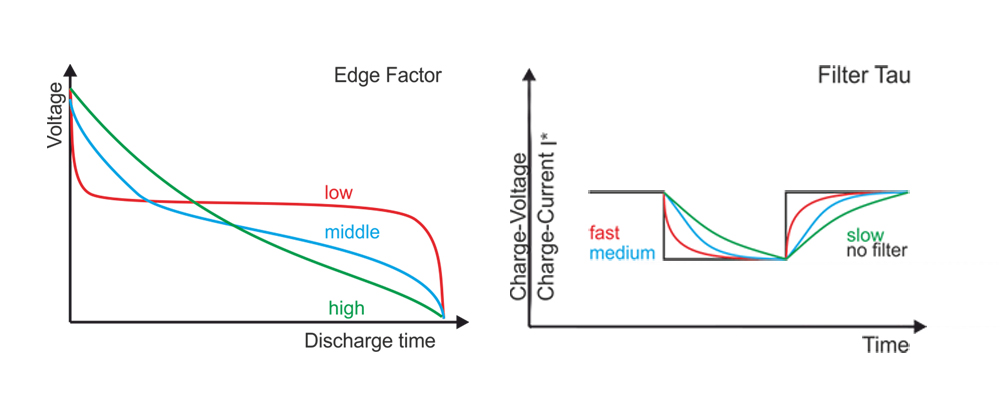
Accurate battery simulation depends on stable system behavior and real-time processing of battery models. Parameters such as internal resistance, voltage characteristics and SOC can be adjusted to represent different battery types. Combined with monitoring and logging functions, this enables reliable and reproducible test conditions even in demanding applications.
Typical Applications for Battery Simulation
EV Charger Testing
In EV charger testing, battery simulation is used to reproduce realistic charging conditions without connecting a physical battery.
Engineers can simulate different battery states, voltage levels and dynamic charging profiles to validate charger performance and control behavior under defined electrical conditions. This is especially important for testing fast charging, load changes and edge cases that are difficult or unsafe to reproduce with real batteries.
Photovoltaic Storage Systems
Battery simulation supports the development and validation of photovoltaic storage systems by emulating the behavior of energy storage units.
It allows engineers to test inverters and storage interfaces under realistic operating conditions, including charge and discharge cycles, fluctuating input from solar generation and varying load demands. This ensures stable system behavior and reliable interaction between generation, storage and grid components.
Grid Stabilization Applications
In grid stabilization scenarios, battery simulation is used to analyze how energy storage systems interact with the electrical grid. Engineers can simulate grid events such as load fluctuations, frequency changes or peak demand conditions and evaluate system response. This enables validation of control strategies, grid support functions and overall system stability without the need for large-scale physical storage installations.
Related topic: grid impedance simulation.
Hybrid Systems
Battery simulation is widely used in hybrid systems to test the interaction between multiple energy sources and power conversion stages.
Typical applications include validating DC/DC converters, energy management strategies and charge/discharge transitions. By simulating different operating scenarios, engineers can analyze system efficiency, control behavior and dynamic interactions between subsystems in a controlled environment.
High Power Systems
For high power applications, battery simulation enables testing under demanding voltage and current conditions that are difficult to achieve with real batteries. This includes large-scale systems such as industrial power applications, grid storage or electrified heavy-duty platforms.
Scalable simulation setups allow engineers to validate system performance, stability and safety across a wide power range, from laboratory environments to high-power installations.
Modular system architectures also enable flexible scaling of power and voltage levels, making it possible to adapt simulation setups from small test environments up to large-scale projects.
Key Requirements for Effective Battery Simulation
Accurate and Bidirectional Electrical Behavior
Effective battery simulation requires precise measurement and control of voltage and current to reproduce realistic battery behavior. In bidirectional battery simulation, this includes both charging and discharging operation, often referred to as bidirectional behavior. Accurate representation of these processes is essential to test how systems respond under real operating conditions,
especially in applications with dynamic load changes or energy feedback.
Flexibility Across Different Applications
Battery simulation must adapt to a wide range of applications, from low-voltage laboratory setups to high-voltage battery simulation and high-power systems. Different use cases require varying voltage levels, current ranges and battery characteristics. A flexible battery simulation setup allows engineers to use the same system across multiple projects and development stages, reducing complexity and increasing efficiency.
Monitoring, Logging and Parameter Access
Reliable testing depends on full visibility of system behavior. Monitoring and data logging enable detailed analysis of voltage, current and system response during test execution. In a modern battery simulation environment, direct access to battery model parameters allows engineers to adjust simulation behavior and evaluate different scenarios, supporting a deeper understanding and faster optimization of the system under test.
Battery Simulation Solutions Based on REGATRON Technology
REGATRON battery simulation solutions are designed to meet the requirements of modern testing and development environments. These battery simulation systems combine precise electrical control, bidirectional operation and scalable system architecture to reproduce realistic battery behavior across a wide range of applications. This enables engineers to implement reliable and flexible battery simulation setups for both laboratory and high-power test scenarios.
Based on this technology, different battery simulation configurations can be adapted to specific application needs, from component-level testing to complex system validation.
Suitable Products

G5.BAS Series
Specialized battery simulator / emulator, delivering high stability & accuracy, and real-time internal resistance simulation. It includes G5.BatSim software supporting customizable battery models across various battery types, an intuitive live viewer, and advanced tools for automated testing and data recording.
- Power Range: 0…9 to 0…5000+ kW
- Voltage Range: 0…60 to 0…3000 VDC
G5.UNV Series
Comprehensive solution for testing / simulation of batteries and fuel cells, testing of (solar) inverters and chargers, and P-HIL applications. It incorporates the advanced functions of the specialized G5 series and is designed to meet diverse requirements in an environment of constantly evolving tasks in areas such as product certification, scientific laboratories, R&D, and prototyping.
- Power Range: 0…9 to 0…5000+ kW
- Voltage Range: 0…60 to 0…3000 VDC

TC.GSS Series
Proven and cost-effective, the versatile TC.GSS series includes optional specialized application software, liquid cooling, and ruggedization for harsh / military environments. Engineered for a wide range of applications, including battery module / pack testing, cycling, emulation, low-voltage micro / mild hybrid system testing, and electric driveline component testing.
- Power Range: 0…32 to 0…128+ kW
- Voltage Range: 0…60 to 0…520 VDC
We Are Here to Support You
Experience our commitment to outstanding customer support at every stage — before, during, and after your purchase. Benefit from our complimentary consultation services from the very beginning to ensure the ideal solution for your needs.
For added flexibility, selected power supplies may also be available for rent. Please contact REGATRON to discuss your specific requirements and to check availability for your application.
Need the Right Power Solution?
We’ll help you define the ideal setup.
Contact us today for expert, personalized support.